Audio clip: Adobe Flash Player (version 9 or above) is required to play this audio clip. Download the latest version here. You also need to have JavaScript enabled in your browser.
Balthazal EJ.
Acute Pancreatitis: assessment of severity with clinical and CT evaluation.
Radiology 2002; 223:603-613
のp 608 より引用抜粋改変
CT Enhancement Values and Pitfalls
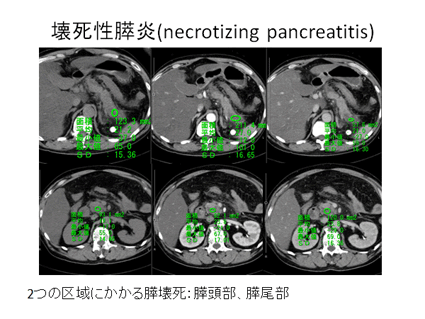
With helical or multidetector scanning with rapid acquisition of sequential images and collimation of less than 5 mm, images can be obtained in the early portal venous phase (60.70 seconds after intravenous administration of 150 mL of iodinated contrast material at a rate of 3 mL/sec). We still use a monophasic protocol, starting at the top of the diaphragm and covering the entire abdomen and pelvis. Since unenhanced images are not obtained, the detection of parenchymal injury is based solely on the degree and homogeneity of pancreatic enhancement. Basic pancreatic CT numbers of 40 .50 HU seen on unenhanced CT images are expected to increase to 100–150 HU throughout the entire normal gland during contrast material administration, depending on the size of the bolus, the speed of the injection, and the time of image acquisition (Fig 3). Lack of contrast enhancement or minimal contrast enhancement of less than 30 HU of a portion of the pancreas or of the entire pancreas indicates decreased blood perfusion (ischemia) and correlates with the development of necrosis (Figs 1, 4, 6). In this regard, however, several factors and potential pitfalls should be kept in mind.
上記もととなったと考えられる膵壊死と病理の対比論文
Larvin M, Chalmers AG, McMahon MJ.
Dynamic contrast enhanced computed tomography: a precise technique for identifying and localising pancreatic necrosis.
BMJ 1990 Jun 2;300(6737):1425-8.
最近の膵壊死のない急性膵炎の予後についての論文
Lenhart DK, Balthazar EJ.
MDCT of acute mild (nonnecrotizing) pancreatitis: abdominal complications and fate of fluid collections.
AJR Am J Roentgenol. 2008 Mar;190(3):643-9.